EN 10204 3.1 Certificate: What It Guarantees and Why It Matters
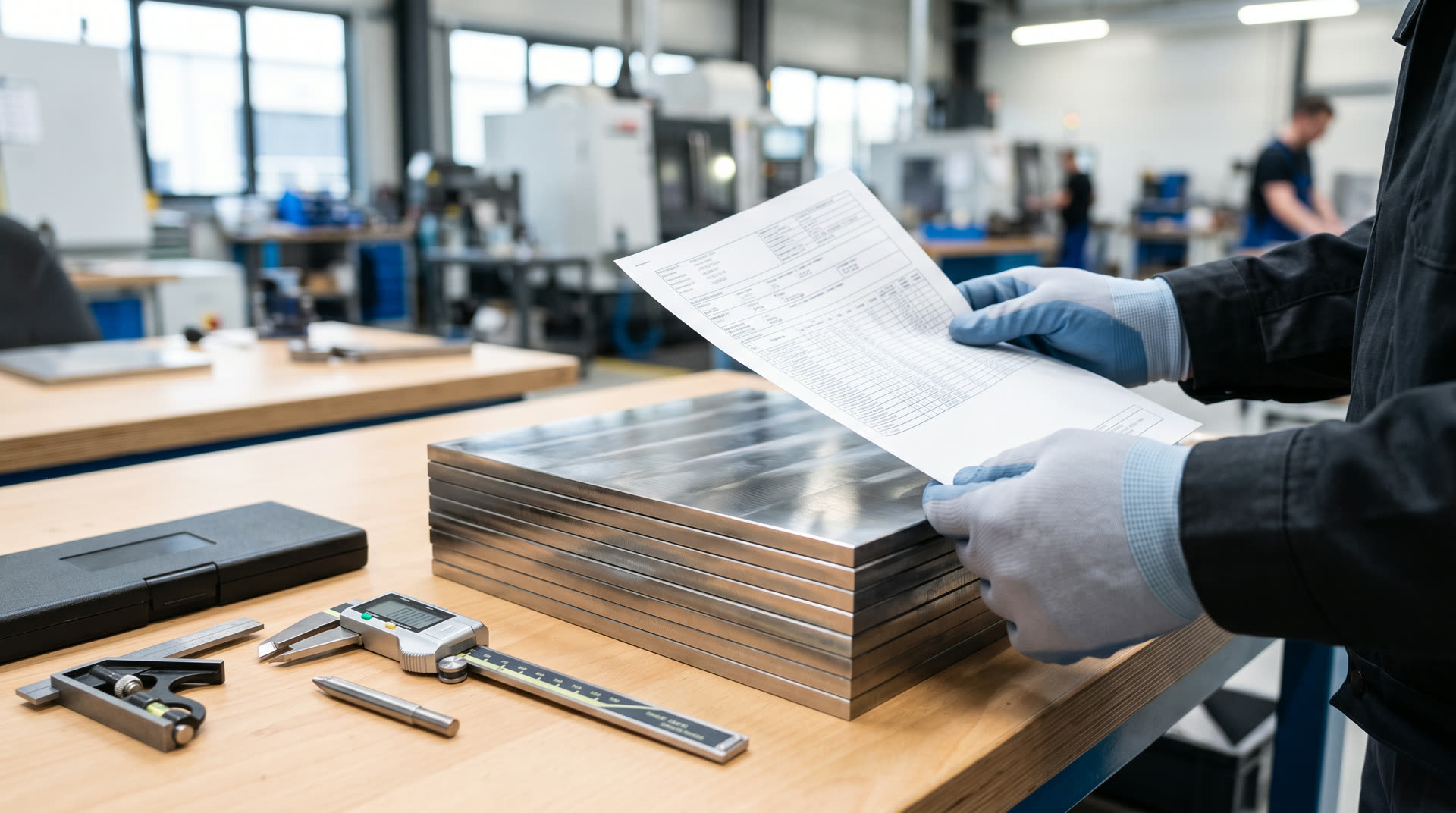
An EN 10204 3.1 certificate is an inspection document in which the steel manufacturer confirms, based on specific tests performed on the actual delivered material, that the product complies with the requirements of the order. It is issued by the manufacturer's own inspection department, which must be independent of the production department. For anyone buying plate, pipe or fittings for pressure equipment, structural work or any application where material properties matter, the 3.1 certificate is the baseline document that turns a steel delivery from a claim into verified fact.
The four document types under EN 10204
The standard defines a ladder of inspection documents, and the differences are worth knowing before you write a purchase order.
Type 2.1: Declaration of compliance
The manufacturer simply declares that the products comply with the order. No test results are included. This is a statement of good faith, suitable only for uncritical commodity material.
Type 2.2: Test report
The manufacturer declares compliance and attaches test results, but those results come from non-specific inspection: tests on production of the same type, not necessarily on your delivered batch. Better than 2.1, still not material-specific.
Type 3.1: Inspection certificate
This is where specific inspection begins. The results in a 3.1 certificate come from tests on the actual products delivered, or on samples from the same heat and treatment lot, and the document is validated by the manufacturer's authorized inspection representative, independent of production. Chemical composition, mechanical properties such as tensile strength and elongation, and heat or batch numbers all appear on the certificate and must match the physical material markings.
Type 3.2: Inspection certificate with third-party validation
Type 3.2 adds an external layer: the certificate is countersigned by an independent third party, such as a classification society or the purchaser's designated inspector, who witnesses or verifies the testing. It is required for the most critical applications and costs accordingly.
What a 3.1 certificate actually guarantees
The certificate ties your specific material, identified by heat number, to measured test values against the ordered specification. In practice it guarantees three things: that the chemistry matches the grade you ordered, for example the molybdenum content that makes 316L what it is, that the mechanical properties meet the standard's minimums, and that traceability exists from the mill's melt through to the plate on your workshop floor. For pressure equipment, this traceability is not optional decoration; design codes and notified bodies expect it, and your own liability position depends on it.
Why you should demand it, even when not forced to
Buyers sometimes skip certification requirements to save a little on price, and it is precisely the cheap offers that deserve the most scrutiny. Without a 3.1 certificate you cannot prove what you installed, cannot respond credibly to a failure investigation, and cannot pass the material along a supply chain where your own customer requires documentation. When KAF Industries supplies plate through its mill direct channel with DKC Stainless, 3.1 certification issued for the specific order is part of the standard scope, details are on our steel business group page.
Protecting yourself from fake or recycled certificates
Certificate fraud exists, from photoshopped values to genuine certificates reused for different material. Practical defenses:
- Match the heat number on the certificate to the hard stamping or marking on the material itself, every time.
- Check internal consistency: grade, dimensions, standard references and test values should all agree with the order.
- Buy through channels with a short, transparent chain to the producing mill, since every intermediate trader is an opportunity for paperwork to drift.
- For critical applications, verify chemistry independently with a spot analysis, for example by portable XRF, which quickly exposes substituted grades.
- Be suspicious of prices well below market for certified material, because the discount often lives in the paperwork.
Certified material through a short chain
KAF Industries supplies hot rolled stainless plate as the authorized Turkey sales representative of DKC Stainless, with certificates issued by the mill for your specific order, and applies the same documentation discipline to carbon steel supply and coordinated dished head production. A short, verifiable chain from mill to your workshop is the strongest anti-fraud measure available. Specify your requirement at the steel business group or write to us via the contact page. Right product. Right source. Right solution.
Frequently Asked Questions
Is an EN 10204 3.1 certificate mandatory for pressure vessels?
Design codes and regulatory frameworks for pressure equipment generally require traceable, specifically inspected material, which in the European system is satisfied by 3.1 or higher. Confirm the exact documentation level with your design code and notified body, and put it in the purchase order.
What is the difference between 3.1 and 3.2 in practice?
Both certify tests on your specific material. In 3.1 the manufacturer's own independent inspection validates the results, while in 3.2 an external third party also verifies them. 3.2 is reserved for the most critical applications and carries extra cost and lead time.
Can a trader issue a 3.1 certificate?
No. The 3.1 certificate is issued by the manufacturer. A trader may transmit the manufacturer's certificate, and under defined conditions intermediaries must pass on the original documentation without alteration. If the paper trail back to the mill is unclear, treat the certificate with caution.