Cylinders to Bulk Conversion: When a Bulk Gas Tank Pays Off
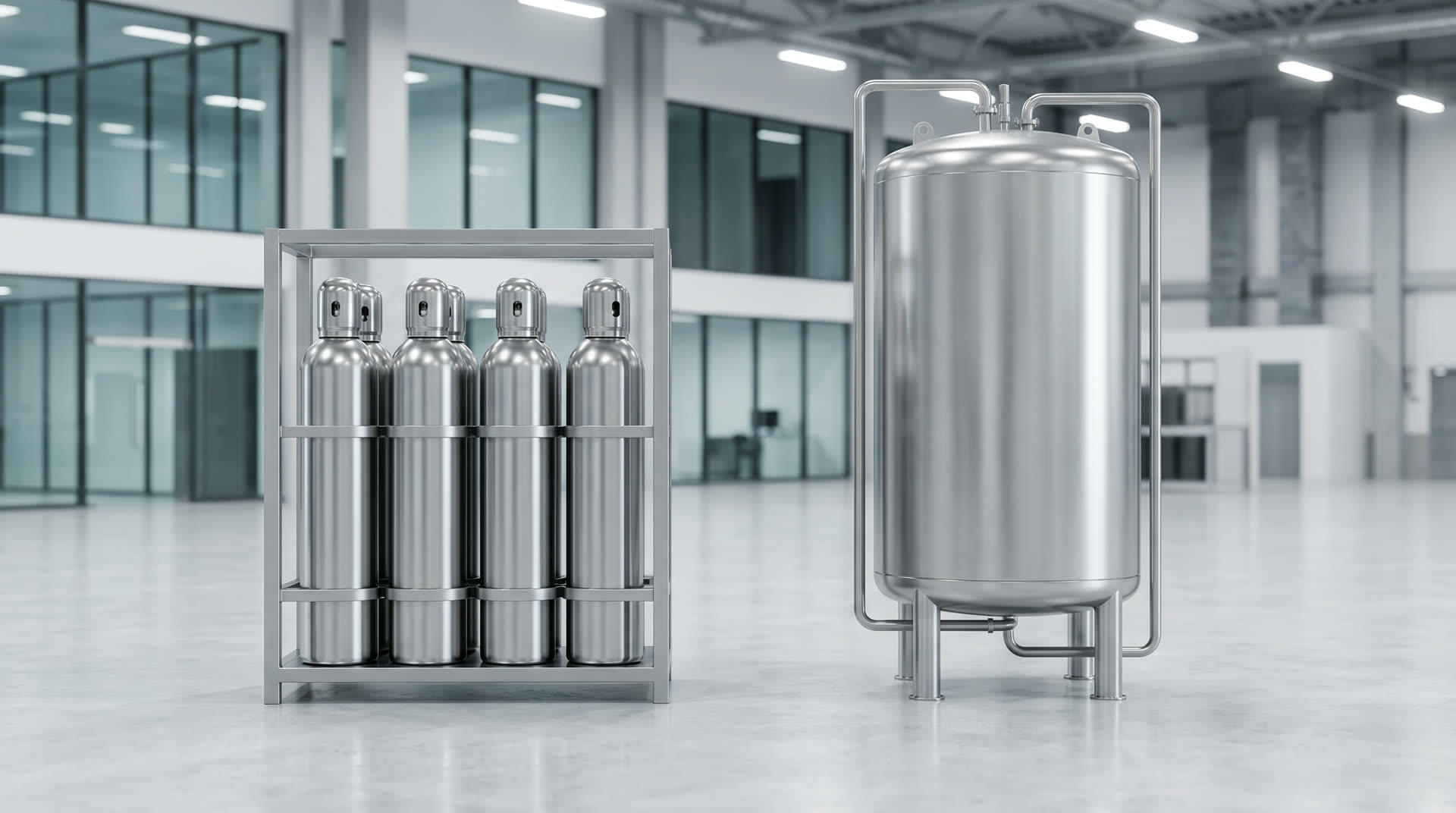
A cylinders to bulk conversion replaces dozens of high-pressure cylinders with a single bulk gas tank filled by road tanker, and it typically pays off once your gas consumption is steady and cylinder deliveries have become a weekly routine. The savings come from four directions at once: lower cost per unit of gas, less handling labor, reduced residual gas losses and a safer site. This article explains the cost logic, the consumption level where the switch makes sense, how to size the tank and why rental is a low-risk way to start.
The cost logic of bulk supply
Lower unit gas cost
Gas delivered in liquid form by tanker costs significantly less per cubic meter than the same gas compressed into cylinders, because you are no longer paying for cylinder filling, cylinder rental, palletizing and piece-by-piece distribution. The more you consume, the wider this gap becomes.
Labor you stop paying for
Cylinder logistics consume quiet hours everywhere: receiving pallets, moving bottles, changing them on manifolds, tracking rentals and returns. A bulk gas tank with a vaporizer feeds your process continuously, and the driver of the delivery tanker does the rest. Most converts are surprised by how much internal labor the old system was absorbing.
Residual losses disappear
Cylinders are returned with residual pressure, which means you routinely give back gas you paid for. Add the product lost during frequent changeovers and the fire drill of running out mid-shift, and cylinder waste often reaches several percent of purchases. Bulk supply eliminates most of it.
Safety improves
Fewer manual handling operations, no cylinder transport around the site and a professionally installed fixed installation reduce the everyday risks that cylinder fleets create. Insurance and safety audits tend to look favorably on the change.
When does the switch make sense?
There is no universal number, but useful signals include: you receive cylinder deliveries weekly or more often, you operate manifolded cylinder packs rather than single bottles, production interruptions due to gas changeovers happen at all, and your monthly gas invoice has become a visible cost line. At that point, ask a supplier to run the comparison with your real consumption data. In many cases the payback on conversion is measured in months, not years.
Our team can run this calculation for you with current figures through the KAF Industries cryogenics group.
Sizing the tank correctly
Tank size should balance three things: your average and peak consumption, the economic delivery size of a road tanker, and the space and permitting realities of your site. A tank sized so that each delivery fills a large portion of its capacity keeps logistics efficient, while enough buffer above normal consumption protects you from delivery delays. Pressure rating and vaporizer capacity must match your process demand, including peak flow, not just the average.
Start with rental, convert when proven
The elegant feature of a cylinders to bulk conversion is that you do not have to buy anything on day one. Starting with a rented tank and vaporizer package turns the project into a monthly operating cost with no capital commitment, and lets you validate the consumption assumptions with real data. Once demand is proven, you can continue renting, move to a longer lease or purchase the tank outright.
One partner for the tank and the gas
KAF Industries covers both halves of the conversion. On the equipment side we supply new and used cryogenic tanks, vaporizers, rental and leasing options through our cryogenics business group. On the molecule side we act as an international supply partner for industrial gases and CO2 through our gases business group. Write to us via the contact page and we will assess whether bulk conversion pays off for your site. Right product. Right source. Right solution.
Frequently Asked Questions
What monthly consumption justifies a bulk gas tank?
As a rough orientation, sites that receive cylinder or pack deliveries every week and run manifold systems are usually already in bulk territory. The precise threshold depends on your gas type, local pricing and logistics, so have a supplier model it with your actual invoices.
How much space does a bulk installation need?
A typical installation needs a concrete foundation for the tank, clearance distances defined by safety standards, tanker access for deliveries and space for the vaporizer. Many fit into a corner of an existing yard. A site survey settles the question quickly and at no obligation.
Can I keep some cylinders after converting to bulk?
Yes, and many operations do. A small cylinder reserve for backup, laboratory use or remote workstations complements the bulk system. The goal is to remove cylinders from your core continuous consumption, where they cost the most.